
Good morning, and happy Thanksgiving week!
Contract signings on existing homes hit a record low for the second month in a row, and builders pulled back on new permits. The Fed's latest minutes showed most officials expect to keep raising rates, yet mortgage rates still had a better week, thanks mostly to a shaky stock market. That same stock market came roaring back this morning, and that matters for rates this week. Let's get into it!
- Contract Signings Hit Another Record Low
- The Fed Minutes, and a Better Week for Rates
- A Quick Look at the Valley
- I'm Often Asked: When Do Contracts Turn Around?
- Weekly Rate Recap and What to Expect This Week
Contract Signings Hit Another Record Low
The National Association of Realtors reported Wednesday that pending home sales, which track signed contracts, fell 4.7% in October and 16.7% from a year ago. NAR's index dropped to 63.0, a record low for the second straight month (100 equals the average contract pace of 2001, when the index began). Contracts usually close in one to two months, so this is our early read on November and December closings. NAR's chief economist said 2026 existing-home sales could end up the lowest since the mid-1990s, even though the country has roughly 75 million more people than it did then.
Builders are pulling back, too. The Census Bureau said building permits fell 7.4% in October to a 1.295 million annual pace, 8.7% below a year ago, and single-family permits fell to 772,000, down 12.9% from a year ago. Housing starts did rise 9.9%, but Census says that move falls inside its margin of error, so I wouldn't read much into it.
Contract signings fell in every region. Here's each region's NAR index, with Census building permits from a year ago:
- West (includes Arizona, California and Colorado): 45.8, down 6.9% from September and 20.3% from a year ago, the weakest of any region. Permits were down 20% from a year ago.
- South (includes Texas): 74.5, down 6.3% from September and 18.7% from a year ago, still the highest index of the four. Permits were down 8.3%.
- Midwest: 65.5, down 2.7% from September and 14% from a year ago. Permits were up 8.1%, the only region with an increase.
- Northeast: 58.5, down 0.8% from September and 11.1% from a year ago, the smallest drops. Permits were down 6.9%.
Here's how this October stacks up against every October since 2016:
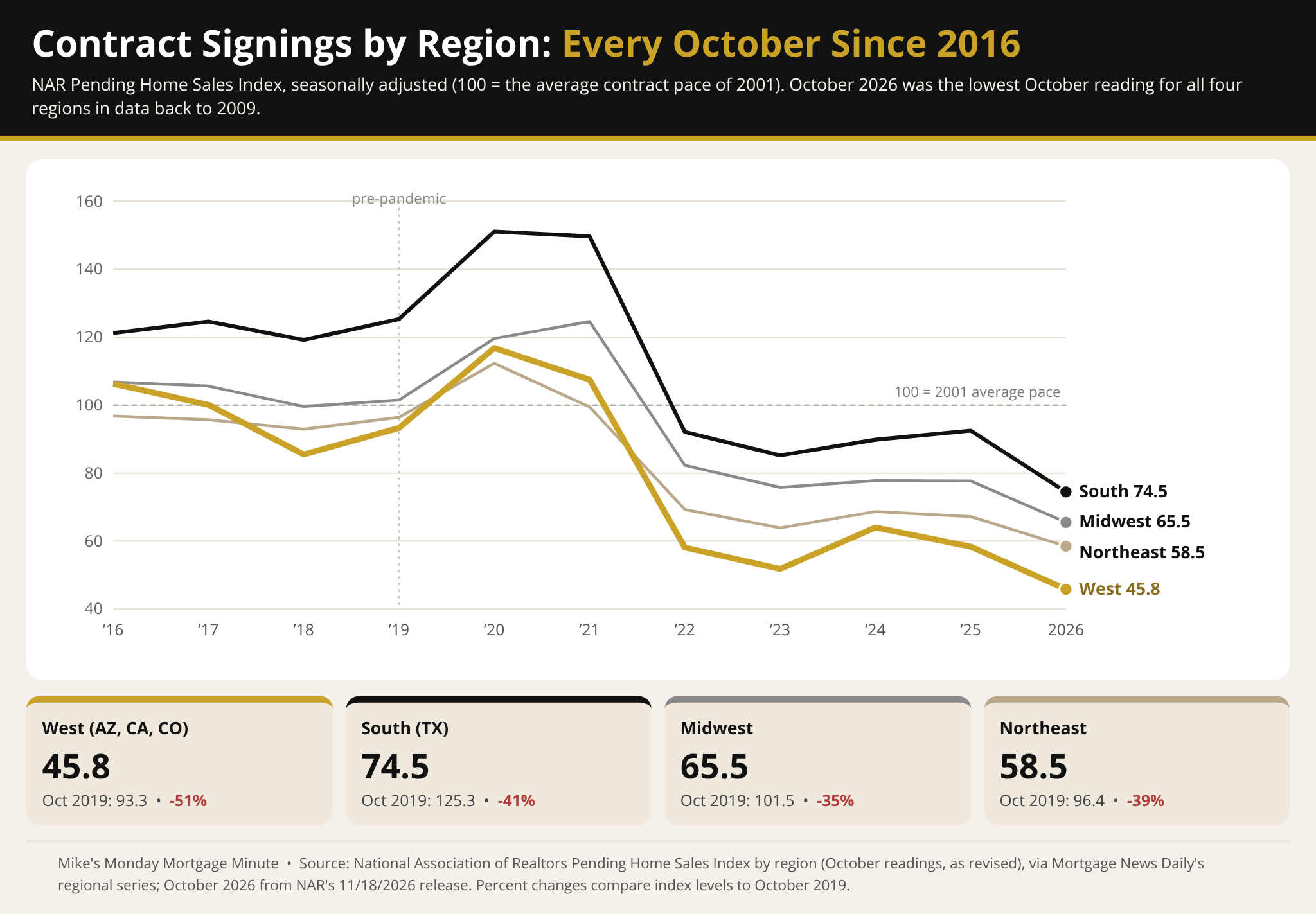
The take home point being: fewer contracts now means a slow finish to the year for closings, and fewer new homes coming down the pipeline later.
The Fed Minutes, and a Better Week for Rates
Wednesday's minutes from the Fed's October 27-28 meeting confirmed what the vote suggested. The Fed held its short-term rate at 3.75% to 4.00% that day, with two of the twelve voters wanting a quarter-point hike. The minutes say almost all officials expect further rate increases to be appropriate, and a couple said a move bigger than a quarter point could be considered in December if inflation data came in unfavorable. October's core inflation then came in at 0.3%, a tenth hotter than expected. Futures markets now see a December hike as close to a sure thing. The minutes also noted that housing and other interest-sensitive parts of the economy were weak, while AI-related investment stayed strong.
Elsewhere, last Tuesday's retail sales were essentially flat in October, up 0.2%, which the Census Bureau says isn't statistically different from zero. Shoppers are pacing themselves heading into the holidays.
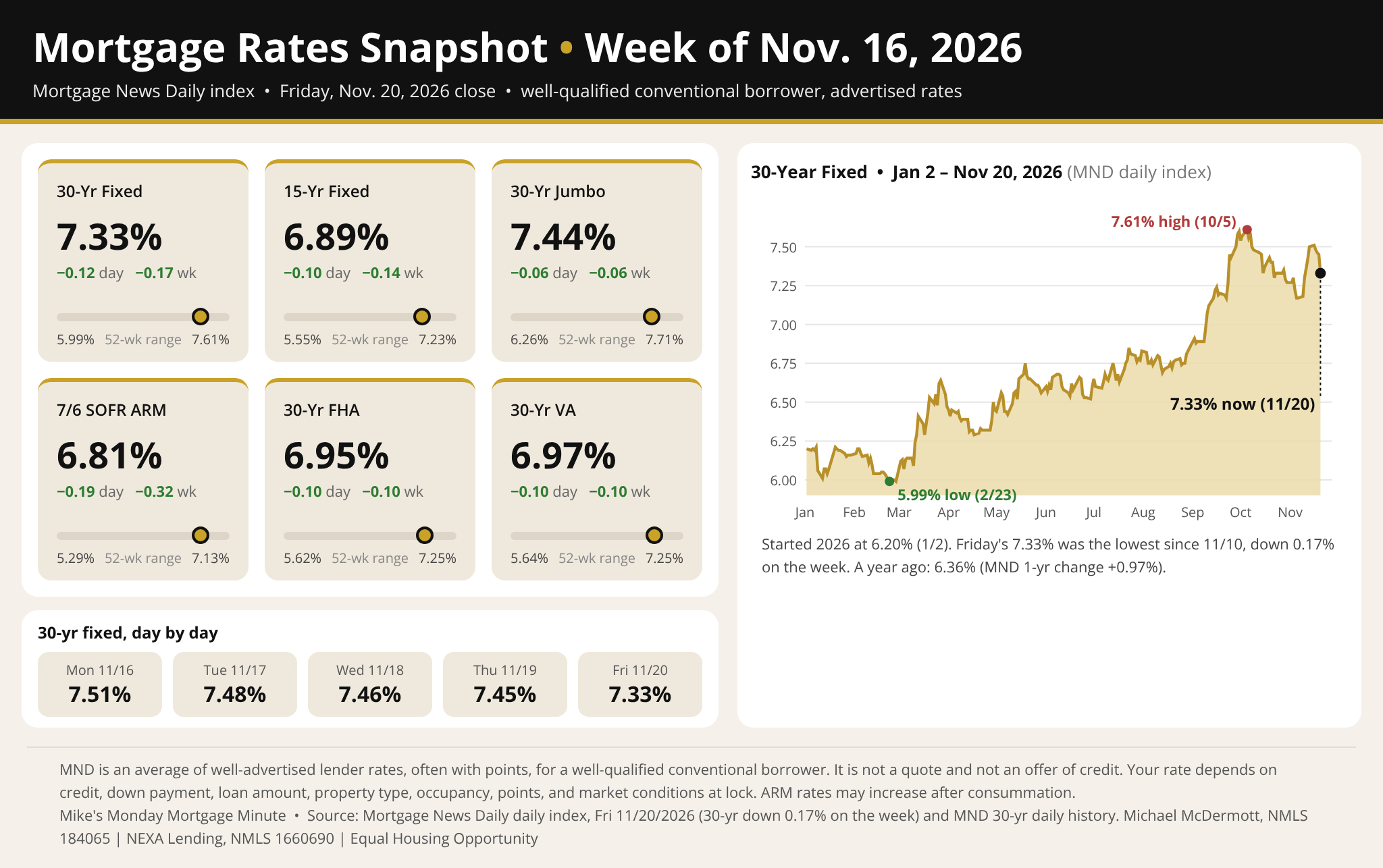
Even so, mortgage rates had a better week. Since mid-October, much of the help for rates has come from a choppy stock market and worries over AI spending. Friday was the big day: with several large tech stocks down more than 10%, money moved into bonds, and the 10-year Treasury yield slipped back below 5%, to 4.92% from 5.15% a week earlier. Mortgage rates followed, and the 30-year fixed average gave back about half of the prior week's jump.
Translation: the relief came from stocks falling, not from inflation cooling. That's a more fragile kind of help, and it can reverse quickly if stocks bounce or the inflation data runs hot.
Case in point: stocks came roaring back this morning after Nvidia's board reinstated Jensen Huang as CEO, less than two weeks after he stepped down. As of midday, the Nasdaq was up around 6% and the S&P 500 roughly 4% to 5%, clawing back more than half of last week's losses. Some of the money that ran to the safety of bonds on Friday is heading back out, so Treasury yields are edging higher, led by shorter-term yields. The 10-year was only a few hundredths higher, around 4.95%, and mortgage bonds were holding up fine as of midday. Bottom line: Friday's relief for rates was real, but it was borrowed from a falling stock market, and the market wants some of it back.
A Quick Look at the Valley
The Valley is tilting further toward buyers. The Cromford Market Index, which weighs buyer demand against supply (100 is balanced, and lower numbers favor buyers), stood at 62.4 as of Saturday, down 17.9 points from three months ago. Over the past two weeks, supply kept rising while demand slipped. Of the 7,269 listings that left the market in the past month, 63% ended in a sale; the rest were cancelled or expired. Cromford's price index, which compares like-for-like homes, is down 2.2% from a year ago.
Translation: well-priced homes are still selling, but sellers pricing off last spring's comps are sitting. Buyers have time and leverage, and that's an opportunity for anyone ready to move this winter.
I'm Often Asked: When Do Contracts Turn Around?
Men lie, women lie, numbers never lie (but they can be skewed or cherry-picked). So here are the numbers...
November and December existing-home closings will come in at or below October's 3.75 million pace, and I don't expect contract signings to turn up in a lasting way before at least spring 2027, roughly March or April.
Why? October contracts fell 16.7% from a year ago, while October closings were down 8.8%. Contracts are falling about twice as fast as closings, and today's contracts are the next two months of closings. Rates are still about a full percentage point higher than a year ago, and the Fed's own minutes point to more hikes, with markets expecting the next one at the December 8-9 meeting. Contract activity also slows every winter, so the next real test is the spring market.
What could speed it up: a sustained drop in rates. Friday showed how fast that can happen when stocks stumble. More sellers adjusting prices, like we're seeing in the Valley, would help too. What could slow it down: a December hike that comes with tough talk about January, a hot inflation reading on Wednesday, or the 10-year Treasury pushing back above 5%.
The bigger reason contracts are stuck: the affordability crisis isn't coming, it's here. NAR's affordability index fell to 100.7 in October, which means a median-income family now earns just barely enough to qualify for the median-priced home. In 2019 it was 159.7. Back then, principal and interest on the median home took 15.7% of the median family's income, and today it takes 24.8%, before taxes and insurance. Add those in and the Atlanta Fed says the typical household needs about 44% of its income to own the median home, and the monthly cost in dollars is the highest on record. To be fair, late 2023 was a little worse as a share of income, and the early 1980s were worse still.
So why aren't prices crashing? Because most owners aren't under pressure. About 41% of owner-occupied homes have no mortgage at all, according to the Census Bureau, and ATTOM says 41% of homes with a mortgage owe half or less of what the home is worth. Put those together and roughly two out of three owners have at least 50% equity. Those folks don't have to sell, and most won't sell cheap.
The math on getting back to normal is sobering. At today's rates, prices would have to fall about 36% to get the payment back to its 2019 share of income, and I don't see that happening. The more likely path is the slow one: flat prices with wages growing 3% to 4% a year. At today's rates, that takes 12 to 15 years to get all the way back to 2019. If rates came down about two percentage points, it's more like 7 to 9 years, and we'd be about halfway there almost right away. Redfin ran similar math against a looser 2018 benchmark and landed between 2029 and 2032, depending on rates. Translation: time and incomes fix affordability, not a crash, and anyone waiting for 2019 prices with 2019 rates is going to be waiting a long time.
None of this means buying is a bad idea. If you're looking to settle in for the long haul, with a fixed payment you're comfortable with, room for the kids to grow and a place to put down roots, owning a home still makes a lot of sense. Where it gets tougher is the quick flip or the one-year stay, because today's costs take time to work out in your favor.
Weekly Rate Recap and What to Expect This Week
The 30-year fixed average fell 0.17% on the week, ending at its lowest level since November 10, though it's still about one percentage point higher than a year ago.
This is a short week with a busy Wednesday. New York Fed President John Williams speaks this afternoon, one of the Fed's most-watched voices heading into the December meeting. Tuesday brings the Case-Shiller home price index (September data) and consumer confidence. Then Wednesday packs in most of the week's data, because markets are closed Thursday for Thanksgiving. We get October's PCE inflation report, the Fed's preferred gauge. In September, it was running 3.6% over the past year, with core at 3.1%. The same morning brings the second estimate of third-quarter GDP, weekly jobless claims a day early, durable goods orders, and October new home sales. The Fed's Beige Book, a roundup of business conditions across the country, comes out that afternoon.
A hot PCE number would likely push rates back up and lock in expectations for a December hike, while a soft one could extend last week's relief. Holiday trading is usually thin, so moves late in the week can be bigger than the news behind them. Remember, the Fed's short-term rate is not your mortgage rate.
I hope you and your family have a wonderful Thanksgiving. I'm grateful for every one of you and the trust you place in me with your clients.
As always, reach out if you have any questions or would like to discuss anything further. Have a great week!
Sources
- National Association of Realtors, Pending Home Sales, October 2026
- HousingWire, Pending Home Sales Index levels, October 2026
- Census Bureau, Monthly New Residential Construction, October 2026
- Federal Reserve, FOMC minutes, October 27-28, 2026
- Census Bureau, Advance Monthly Retail Trade, October 2026
- Mortgage News Daily rate index
- U.S. Treasury, Daily Treasury Par Yield Curve Rates
- The Cromford Report, Greater Phoenix market, November 22, 2026
- National Association of Realtors, Housing Affordability Index
- Federal Reserve Bank of Atlanta, Home Ownership Affordability Monitor
- ATTOM, Q2 2026 U.S. Home Equity & Underwater Report
- Realtor.com Economic Research, Mortgage Status, ACS 2025
- Redfin, U.S. Housing Costs Could Return to “Normal” Within 5 Years, October 8, 2026
- NVIDIA Newsroom, Board Reinstates Jensen Huang as President, CEO and Board Director, November 23, 2026
- Federal Reserve, FOMC meeting calendars
- Bureau of Economic Analysis, news release schedule