
Good morning,
October hiring came in much stronger than expected, with other labor market reports offering additional insight into the broader picture. Here’s what you need to know.
- October Jobs Report Shows Surprising Strength
- Stocks Tumbled. Bonds Barely Noticed
- A Look at the Valley Market
- Weekly Rate Recap and What to Expect This Week
October Jobs Report Shows Surprising Strength
October hiring came in well above expectations, with the economy adding 165,000 jobs versus forecasts of around 65,000. August and September were also revised higher by a combined 84,000 jobs, and the unemployment rate edged down from 4.2% to 4.1%.
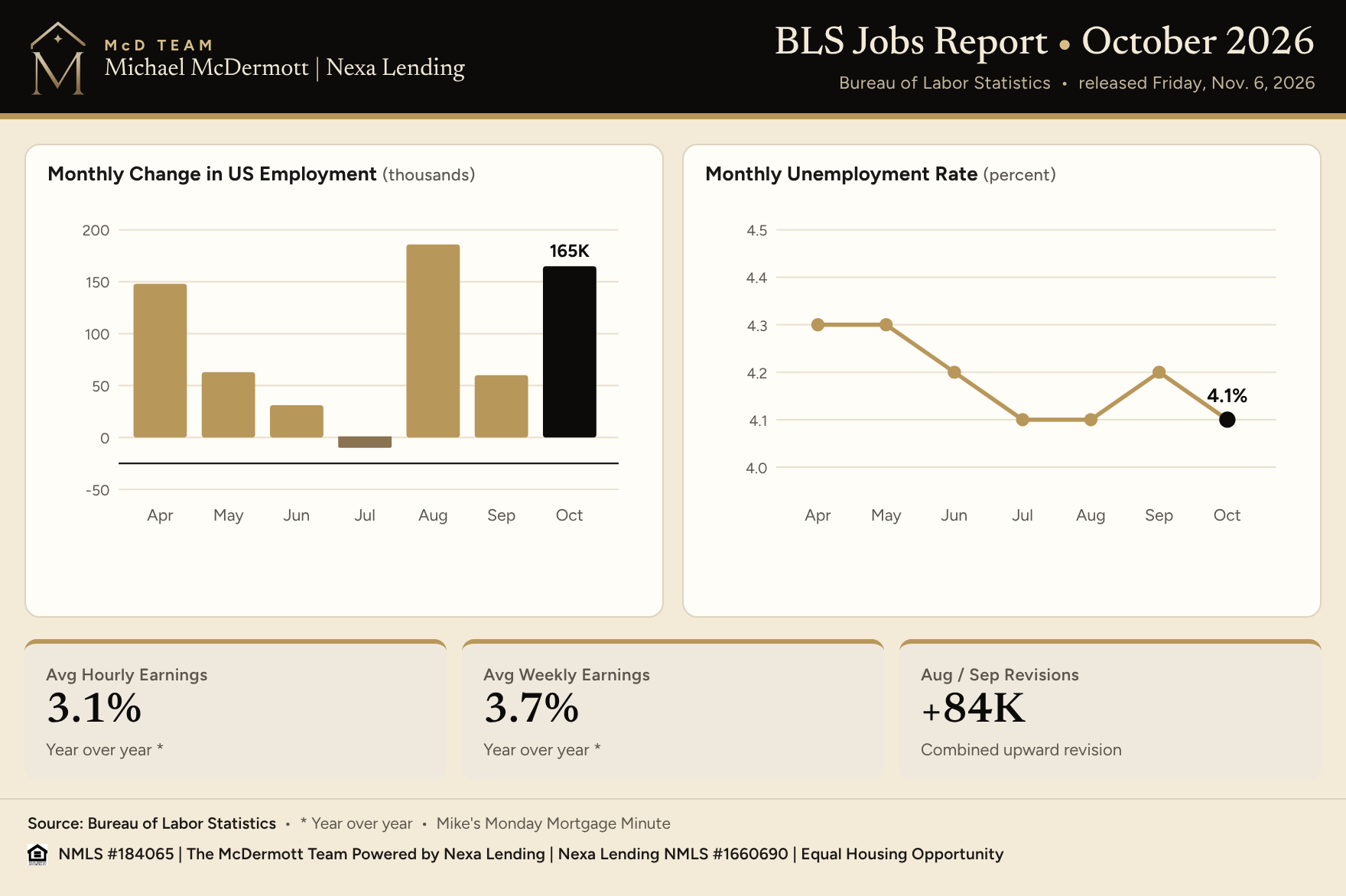
There were encouraging details beneath the headline, too. Full-time employment rose by 714,000, while part-time employment fell by 242,000. And the unemployment rate dropped for the right reasons: about 421,000 people joined the labor force, so this wasn't people giving up and leaving the job market.
ADP also reported "solid growth" in private hiring for a second straight month, after much weaker gains in July and August. Still, the picture isn't uniform. ADP shows professional and business services losing jobs for the third straight month, a sector many are watching for the impact of AI, though the government's count showed that sector adding 70,000 jobs in October. Health care remains a steady engine, adding 42,000 jobs, likely reflecting rising demand as the population ages.
There is one important caveat. Monthly jobs numbers from the Bureau of Labor Statistics (BLS) can be volatile and are often revised as more data comes in. This report was also much stronger than other recent reads on the labor market: ADP estimated 86,000 private jobs, and Revelio Labs just 26,000. We'll watch for revisions to October in the coming months. If this strength holds up, it gives the Federal Reserve more room to raise rates again at upcoming meetings, and markets are already leaning toward a hike in December.
Stocks Tumbled. Bonds Barely Noticed
Thursday was brutal for stocks, especially technology companies. Worries about data-center construction and AI spending sent the Nasdaq down 5.5% and into a correction, its worst day since the April 2025 tariff shock. The selloff wiped out roughly $3 trillion in S&P 500 market value, the largest single-day dollar loss on record. Friday brought only a partial rebound, and the S&P 500 still finished down about 2.7%, its worst week since April 2025.
The trigger was political. After Democrats won control of both the House and Senate, along with governorships in several big data-center states, investors worried that new limits on AI infrastructure were coming. Texas governor-elect Gina Hinojosa, for example, has called for a pause on new data centers, and congressional Democrats have pushed to shield consumers from data-center power costs and to require independent testing of AI systems. Reuters and other major outlets tied Thursday's drop directly to those regulation fears. Restricting expansion or use of AI limits the growth these companies can attain - thus the tech selloff.
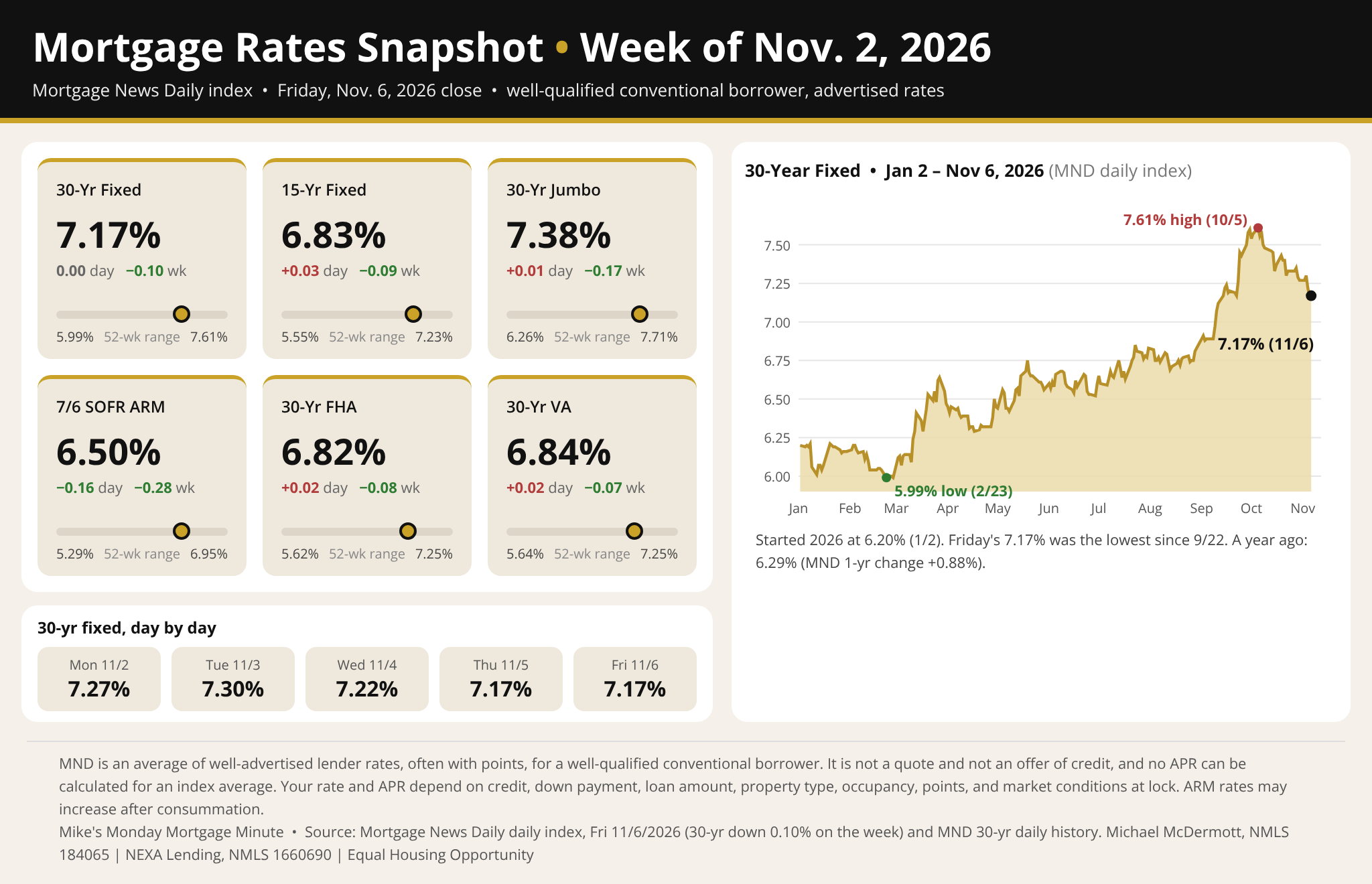
Normally, a selloff like that is good news for mortgage rates. When investors pull money out of stocks, much of it flows into the relative safety of bonds, and that bond buying pushes yields and mortgage rates down. So, the selloff helped rates, as you'd expect. What stood out was how little it helped. With a record-setting loss in stock value, you might have expected bonds to rally much harder. Instead, mortgage rates improved only from about 7.22% to 7.17% over those 24 hours, then held flat Friday to end the week slightly lower than the week before.
Why so muted? The strong jobs report was pulling the other way. Solid hiring gives investors a reason to demand higher yields and keeps a December Fed hike on the table. The stock selloff softened that pressure, but it couldn't overpower it.
The takeaway is that falling stocks don't automatically mean meaningfully lower mortgage rates, especially when the economic data is running hot. Also remember that the Fed's short-term rate is not your mortgage rate. Mortgage pricing follows mortgage-backed securities, which are shaped by Treasury yields and broader market conditions. Waiting for a Fed headline is no substitute for looking at the financing available today.
A Look at the Valley Market
AZ Business Magazine’s November 7 report on October’s Metro Phoenix market showed:
- Active listings of 27,427, up 6.8% from a year earlier.
- Closed sales of 5,155, down 9.8%.
- A median sales price of $448,000, down 1.5%.
- Listings under contract down 13.5%.
The modest price dip isn't the real story. The pace of contracts is, and it's slow by historical standards. The Cromford Report's contract ratio is at its lowest level since February 2009. Contract volume in early November looks more like what we'd normally see in a shortened holiday week. The Cromford Market Index fell to 70.1, from 78.8 a year ago and 92.6 two years ago, which puts the Valley deeper into buyer's-market territory. We can argue the exact index reading all we want, but the trend is unmistakable. For now, buyer demand is clearly soft as affordability remains the biggest barrier to more sales.
Buyers have more selection, sales volume is light, and pricing discipline matters. A modest year-over-year median-price decline isn’t enough to call a crash. But it’s also hard to call this a strong seller’s market when inventory is rising and fewer homes are going under contract. For buyers, the opportunity may be in the negotiation, not just the interest rate. Price, seller concessions, and the buyer’s budget all belong in the conversation. What’s available will depend on the property, seller, and loan program.
For sellers, yesterday’s comparable sale doesn’t guarantee today’s result. The Valley isn’t one uniform market, so neighborhood-level conditions still matter more than a metro-wide headline.
Weekly Rate Recap and What to Expect This Week
Inflation takes center stage, with the Consumer Price Index (CPI) due Tuesday and the Producer Price Index (PPI), which tracks wholesale prices, arriving Friday. Thursday brings two other key updates: Existing Home Sales and the latest jobless claims. Right now, the trend is our friend as rates have improved by more than 0.4% since the early-October peak. That can quickly change with the headwinds of inflation still being elevated. Remain on guard and ready to lock quickly if you’re in the market to buy.
Here’s how rates ended the week:
As always, reach out if you have any questions or would like to discuss anything further. Have a great week!