
Happy Monday! Last week was a tug-of-war. Inflation came in hot at both the consumer and wholesale level, oil pushed back above $100 as the Iran conflict flared around the Strait of Hormuz, and yet mortgage rates had one of their better weeks in a while, thanks to a tech-stock selloff that sent investors into bonds. This one is about a 5-minute read. Let’s get into it!
- Inflation Ran Hot: Consumer and Wholesale Prices Both Worse Than Forecasts
- Oil Above $100, a Tech Selloff, and Why Rates Still Fell
- Housing Check-In: Sales Steady, Builders Gloomy, the Valley Tilts Toward Buyers
- Weekly Rate Recap and What to Expect This Week
- What I’d Tell a Buyer or Seller This Week
Inflation Ran Hot: Consumer and Wholesale Prices Both Worse Than Forecasts
On Wednesday, the September Consumer Price Index (CPI) showed prices up 0.6% for the month and 3.7% from a year ago, up from 3.4% in August. Economists expected 3.6%. Core CPI, which strips out food and energy, rose 0.3% for the month and 2.6% for the year, both a notch above forecasts of 0.2% and 2.5%. Then on Thursday, the Producer Price Index, a read on wholesale prices, jumped 1.3% in September and 6.3% from a year ago, the biggest annual gain since 2022.
A few takeaways worth passing along:
- Energy is doing most of the damage. Gasoline jumped 9.1% in September, one single month, and accounted for more than half of the monthly CPI increase. Energy prices overall are up 20.4% from a year ago.
- It’s starting to spread. Core wholesale prices rose 0.7% for the month and 5% for the year, and shelter costs in the CPI rose 0.4%, up from 0.3% in August.
- Paychecks are losing ground. Inflation-adjusted average weekly earnings fell about 0.5% from August to September. Retail sales rose 0.8%, more than expected, but take out autos and gas and spending rose only about 0.2%. People are paying more at the pump and tightening up everywhere else.
- The Fed is hearing it from businesses, too. In Wednesday’s Beige Book, contacts in our own district (the San Francisco Fed’s region, which includes Arizona) said “rising mortgage rates, elevated asking prices, and limited supply curtailed single-family home sales.”
So, what does the Fed do with that? After Thursday’s wholesale report, futures traders put the odds of an October 27–28 hike near 34%, up from under 18% a week earlier. Then Fed Chair Kevin Warsh, speaking Thursday night our time in Bangkok, declined to tip his hand. “I don’t prejudge meetings,” he said. Markets took that as a likely pause. As of this morning, traders see better than an 85% chance the Fed holds on October 28, though many, including Goldman Sachs economists, still expect a hike in December.
Same reminder as always: the federal funds rate is not your 30-year fixed rate. HELOCs and credit cards feel a Fed hike first. Mortgage rates live off the 10-year Treasury, inflation expectations, and the spread between Treasuries and mortgage-backed securities.
Oil Above $100, a Tech Selloff, and Why Rates Still Fell
If you only read the inflation headlines, you’d have expected rates to jump last week. They did the opposite, which is quite unusual.
First, the geopolitical backdrop got worse, not better. At least nine commercial ships came under attack near the Strait of Hormuz in the past week as Iran tried to choke off oil exports, Iran-allied Houthi militants fired missiles at Saudi Arabia, and Ukraine said it would resume strikes on Russian refineries. Brent crude oil touched $110 on Friday for the first time since May and closed at $109.86. U.S. crude settled at $101.41, up more than 10% on the week. Diesel averaged $6.33 a gallon Friday, more than 70% above a year ago. That diesel number matters for housing, too. Builders called it out this morning (more on that below).
Second, the stock market had its worst week since June. The Nasdaq fell 4.5% and the S&P 500 lost about 2%, as investors worried about how much companies are borrowing to build AI data centers. When stocks wobble, money looks for safety in Treasuries.
That flight to safety won out and helped rates. The 10-year Treasury fell from 5.24% to 5.09% for the week, its best week since mid-February, before the Iran war began. Mortgage News Daily traced much of the week’s improvement in mortgage rates to those tech and AI-spending concerns and noted that on Friday rates “refused to follow tech stocks any lower” as oil surged.
Translation: last week’s relief came from fear in the stock market, not from good news on inflation. That kind of rally can reverse quickly if tech stocks steady or oil keeps climbing, so I wouldn’t count on it lasting.
Housing Check-In: Sales Steady, Builders Gloomy, the Valley Tilts Toward Buyers
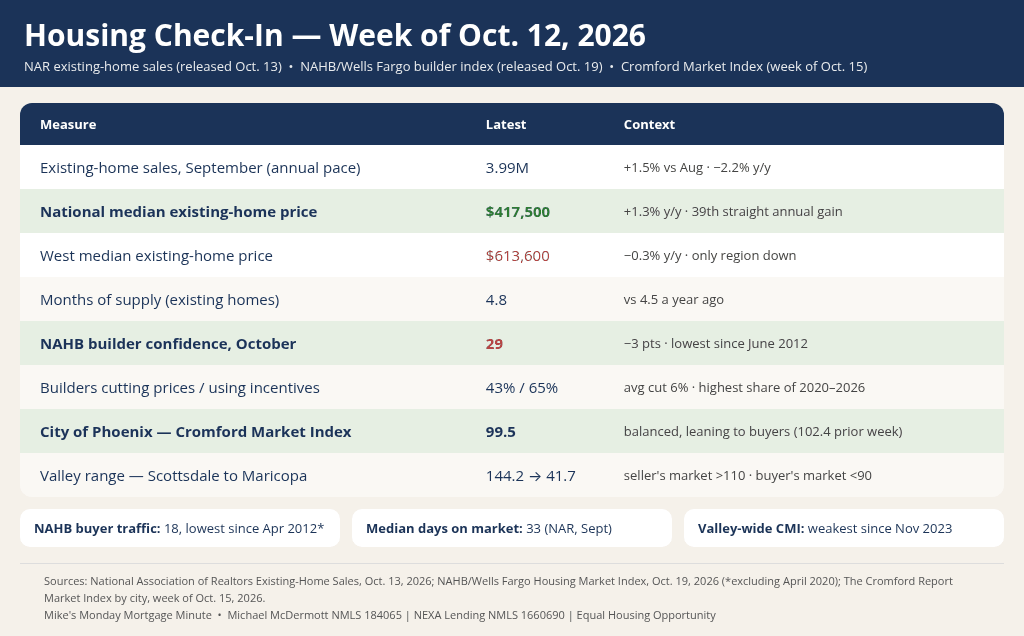
The National Association of Realtors reported last Tuesday that existing-home sales rose 1.5% in September to a 3.99 million annual pace, down 2.2% from a year ago. The national median price was $417,500, up 1.3% from a year ago, the 39th straight month of annual gains. Inventory was a 4.8-month supply, up from 4.5 months a year ago. In the West, the median price was $613,600, down 0.3%, the only region where prices slipped from a year ago. Keep in mind these are closings, so they mostly reflect contracts signed before rates jumped in September.
The take home point being – inventory is growing faster than sales, so the gap between homes on the market and buyer demand is widening.
NAR chief economist Lawrence Yun’s advice to sellers was blunt: “Home sellers need to be realistic about local market conditions, which could require price discounts and other incentives to attract buyers.”
Builders are already there. This morning, the National Association of Home Builders said its builder confidence index fell three points to 29 in October, the lowest builder confidence level reported since June 2012. Buyer traffic dropped to its lowest level since April 2012, setting aside the onset of the pandemic. 43% of builders cut prices in October, the highest share since at least 2020, with an average cut of 6%, and 65% offered sales incentives. NAHB pointed to mortgage rates “well above 7%,” higher gas prices, and higher costs for diesel and materials.
Closer to home, the Valley keeps shifting toward buyers. The Cromford Market Index for the City of Phoenix slipped to 99.5 the week of October 15, down from 102.4 a week earlier. That’s still technically balanced, but leaning toward buyers. The Valley-wide average is the weakest since November 2023, and the spread between cities is huge: Scottsdale is still a strong seller’s market at 144.2, while Queen Creek (45.8), Buckeye (48.5), and Maricopa (41.7) are deep in buyer’s territory. Where you’re buying or selling in the Valley matters as much as the national headline.
I went deeper on what the Phoenix slowdown means for buyers and sellers in a post earlier this month: https://themcdteam.com/blog/phoenix-softening-what-it-means/
Weekly Rate Recap and What to Expect This Week
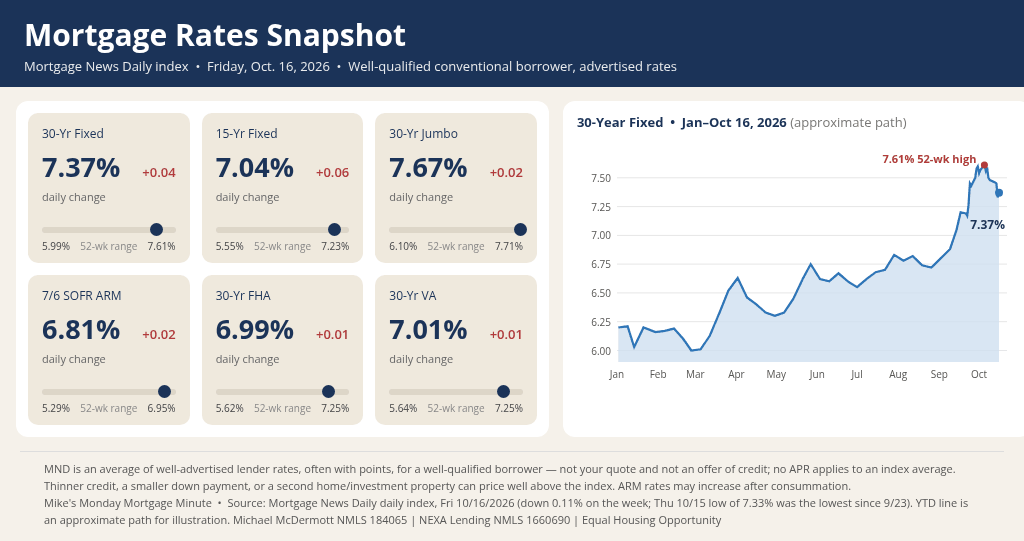
As of Friday, the Mortgage News Daily index for a well-qualified conventional 30-year fixed was 7.37%, down 0.11% for the week and 0.24% below the 52-week high of 7.61% on October 5. On Thursday it touched 7.33%, its lowest since September 23, before ticking back up 0.04% on Friday. The 15-year was 7.04%, jumbo 7.67% (the one product that ticked up on the week), 7/6 SOFR ARM 6.81%, FHA 6.99%, and VA 7.01%. These are averages of advertised rates, often with points, for a top-tier file, not a quote. Thinner credit, a smaller down payment, or a second home or investment property can price well above the index.
Mortgage Bankers Association said purchase applications in the week ending October 9 were 16% below a year ago, and the share of buyers choosing adjustable-rate loans rose to 10.5%, the highest since October 2025.
For perspective, Mortgage News Daily’s index started the year around 6.2%, bottomed near 6.0% in late February, and climbed to roughly 6.75% to 6.8% by August before the sharp jump in September that peaked at 7.61% on October 5. Last week was the first real pushback since then.
It’s a lighter week for data, and the Fed is in its quiet period, so officials won’t be talking policy until after the October 27–28 meeting. With the Fed out of the headlines, oil and the stock market are likely to drive rates this week. Here’s a snapshot of how the week ended, and rates year-to-date.
What I’d Tell a Buyer or Seller This Week
For sellers:
- Price for today’s buyer, not last spring’s. With 43% of builders cutting prices and most offering incentives, resale sellers are competing with new construction. Price it right in the first couple of weeks instead of chasing the market down.
- Know your submarket. The Valley runs from a strong seller’s market in Scottsdale to deep buyer’s markets in Queen Creek, Buckeye, and Maricopa.
- Put concessions where they do the most work. A seller credit toward a rate buydown or closing costs can do more for a buyer’s monthly payment or cash to close than the same dollars off the price. Caps still apply: conventional runs 3% to 9% of the price depending on the down payment (2% on investment properties), FHA allows up to 6%, and VA caps concessions at 4% of the reasonable value (normal closing costs don’t count toward that 4%). I’m happy to run a credit versus a price reduction side by side for any buyer you’re working with.
For buyers and homeowners:
- Last week was a window. Have a plan for using it. Rates are about a quarter point below where they were two weeks ago, but that relief came from a stock-market scare, and it can reverse fast. If you’re under contract, decide your lock plan now.
- Compare all your options. On Friday’s index, FHA (6.99%) and VA (7.01%) are more than a third of a point below conventional. FHA carries mortgage insurance (and so can conventional), and VA has a funding fee unless you’re exempt, so the lowest rate isn’t always the lowest total cost. If you look at an ARM, know that the 7/6 SOFR ARM is fixed for the first seven years, then can adjust every six months, up or down, within caps, and the rate may increase after closing.
- New construction deserves a look, with eyes open. Ask whether a buydown is permanent or temporary, whether it’s tied to the builder’s lender, and what the full payment is either way. On a temporary buydown, conventional loans still require you to qualify at the full note rate.
- Leave yourself breathing room. With gas and groceries costing more, don’t stretch to the top of your approval. A future refinance is an option, not a promise, and it has its own costs.
If you have any questions or would like to discuss this week’s newsletter further, please don’t hesitate to reach out. Have a great week!
Rates referenced are Mortgage News Daily national index averages of advertised rates as of Friday, October 16, 2026, shared as market commentary only. They are not an offer of credit or a rate quote from Michael McDermott or NEXA Lending, and an APR cannot be calculated for an index average. Your actual rate and APR depend on credit, loan amount, down payment, property type, occupancy, points, and market conditions at the time of lock. ARM rates may increase after consummation. All loans are subject to credit approval and program guidelines.
Michael McDermott, MLO NMLS 184065 · NEXA Lending, Company NMLS 1660690 · AZBK 2006218 · Equal Housing Opportunity