
Happy Monday!
Last week brought big housing headlines. The President signed an executive order on housing costs, contracts to buy existing homes fell to a record low, and mortgage rates eased to near one-month lows as a tech-stock selloff pushed money into bonds. This week, the Fed meets. This one is about a 5-minute read. Let’s get into it!
- A New Housing Executive Order: What It Does, and What It Doesn’t Do Yet
- Contracts Hit a Record Low as Buyers Face Affordability Crunch
- Housing Check-In: Contracts Slump Nationally, and DFW Buyers Still Have Room to Negotiate
- Weekly Rate Recap and What to Expect This Week (the Fed Meets Wednesday)
A New Housing Executive Order: What It Does, and What It Doesn’t Do Yet
On Thursday, President Trump signed an executive order titled “Decreasing Housing Costs for the American People.” Here’s what it asks agencies to do, in plain English:
- Mortgage insurance. If FHFA’s Director determines it’s in the best interest, Fannie Mae and Freddie Mac would start a pilot to cancel private mortgage insurance proactively once a borrower meets the equity requirements, using automated valuations or current home values. The pilot would apply only to loans made after it is set up, not existing loans.
- Title costs on refinances. FHFA is directed to expand the title acceptance pilot into an ongoing nationwide program. In that program, an automated title review can stand in for a lender’s title insurance policy on eligible refinances, thus reducing the title fees collected at closing.
- Refinance costs. The order also lists waiving appraisals, income re-verification, and documentation for limited cash-out refinances that lower the payment, and reducing or eliminating loan-level price adjustments and fees, with any savings passed on to borrowers.
- Manufactured housing. HUD and FHFA will co-chair a task force, with recommendations due in 180 days that outline ways to improve affordability for manufactured housing.
- USDA and VA direct loans. Both agencies are directed to reduce rates on single-family loans they make directly. That’s their direct-lending programs, not the much more common guaranteed loans most buyers use.
Translation: these are directives, not rule changes. Nothing changes on a loan transaction today. The details have to come from FHFA, Fannie Mae, Freddie Mac, USDA, and VA, and I’ll pass them along as they’re released. I wouldn’t tell anyone to time a purchase or refinance around it.
Contracts Hit a Record Low as Buyers Face Affordability Crunch
Last Tuesday, the National Association of Realtors reported that pending home sales fell 7.3% in September and were down 11.3% from a year ago. The index dropped to 66.0, the lowest since the series began tracking in 2001. Economists had expected a 0.5% dip. Pending sales track signed contracts, so this is the first clear national read on how buyers handled September’s rate jump.
Contracts fell in all four regions. Here’s how each one did in September:
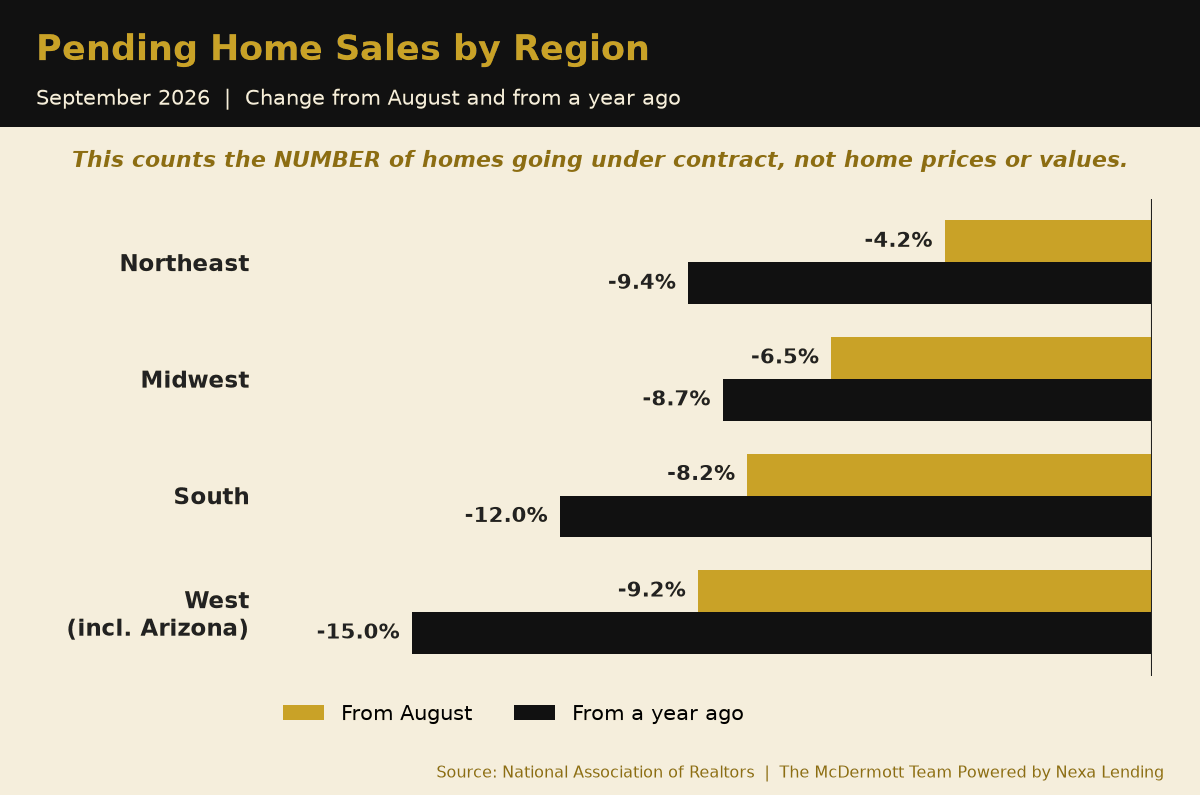
NAR chief economist Lawrence Yun put it simply: “Market conditions weakened in September due to fast-rising mortgage rates,” and “buyers and sellers may simply be holding back until mortgage rates move favorably.” I agree with Yun, but rates aren’t the only thing holding buyers back. Inflation, especially oil and diesel, is showing up at the pump, in shipping costs and at the grocery store, and the higher cost of living has buyers putting big purchases like a home on hold.
Housing Check-In: Contracts Slump Nationally, and DFW Buyers Still Have Room to Negotiate
Closer to home, the Dallas-Fort Worth numbers line up with the slowdown in contracts. MetroTex’s September report from NTREIS data shows the single-family median sales price at $385,000, down 1% from a year ago, while pending sales (signed contracts) fell 19%. Homes averaged 62 days on the market, sellers received 93.9% of list price, and supply stood at 4.3 months, with active listings down 2% from a year ago. Townhomes are softer: a $355,000 median (down 11%) and a 5.8-month supply.
Realtor.com’s September report for the Dallas-Fort Worth metro found that 27.5% of listings took a price cut, compared with 20.8% nationally. Active listings were down 2.3% from a year ago, versus up 5.4% nationally.
Weekly Rate Recap and What to Expect This Week (the Fed Meets Wednesday)
As of Friday, the Mortgage News Daily index for a well-qualified conventional 30-year fixed was 7.33%, down 0.04 points for the week. Here’s a snapshot of how the week ended, and rates year-to-date:
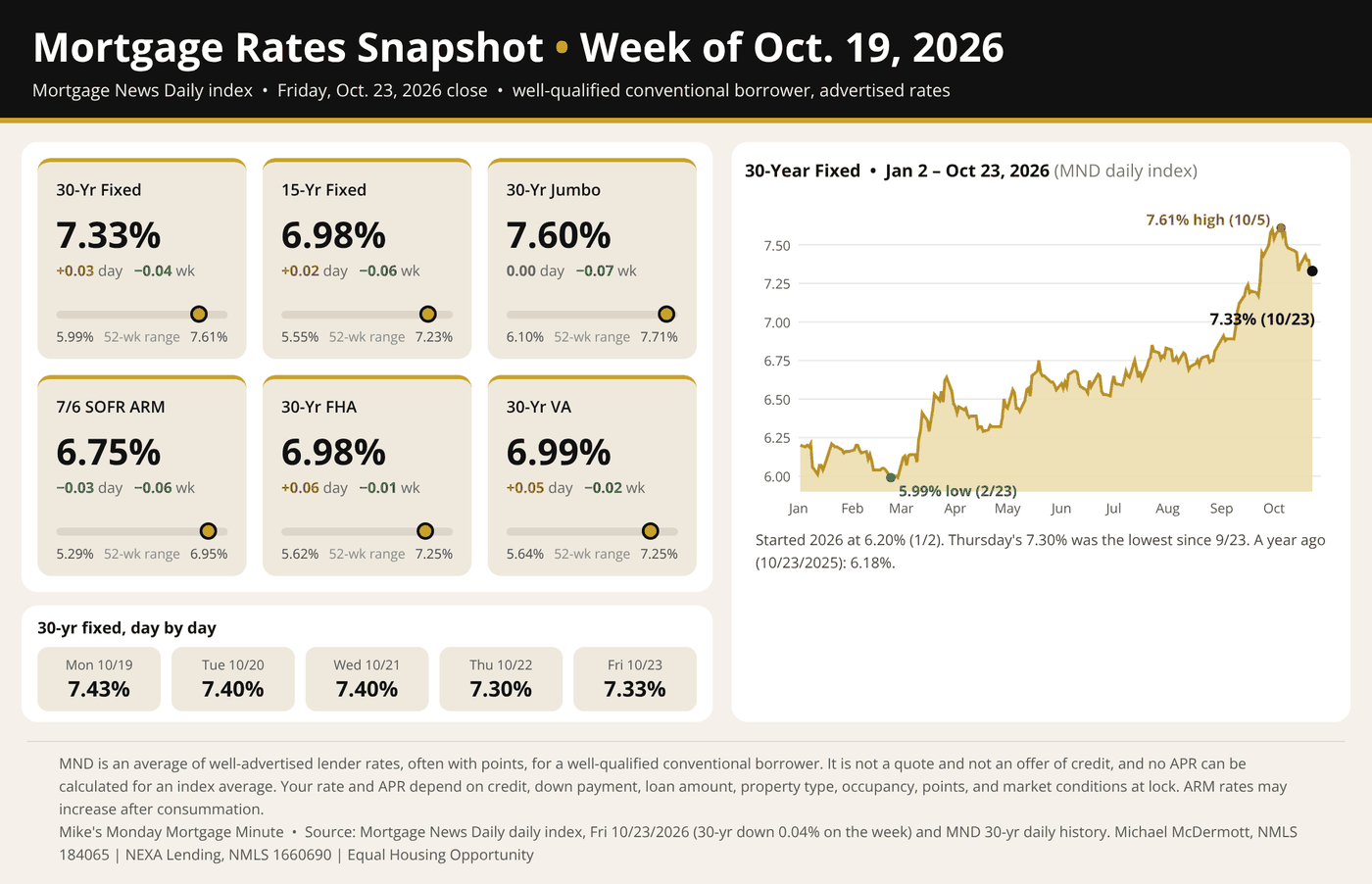
Why the improvement? Mortgage News Daily’s Matthew Graham tied it to worries about debt-fueled AI spending. When tech stocks sold off hard on Thursday, he summed it up: “tech is tanking and bonds are picking up the slack.” When tech steadied on Friday, rates inched back up. The 10-year Treasury ended the week near 4.99%, down from 5.09% the Friday before. Translation: this relief is coming from stock-market nerves, not from better inflation news, and that can reverse quickly, pushing rates higher again.
The Fed meets Tuesday and Wednesday. The October 27–28 meeting is the first since September’s quarter-point hike put the federal funds target at 3.75% to 4.00%. Futures markets are pricing no rate hike or rate cut. In a Reuters poll, 94 of 100 economists expect no move as well, and all 100 expect a hike in December. However, there are outliers like Bank of America still looking for a hike. I don’t think we’ll see a hike at this meeting but the December meeting could be a different story.
Remember that the federal funds rate is not your 30-year fixed rate. Mortgage rates follow the 10-year Treasury and mortgage-backed bonds, which react to the Fed’s tone. A message leaning on inflation could push yields up; one leaning on a cooling economy could pull them down.
- Wednesday: Fed statement at 2 p.m. Eastern (1 p.m. Central), then Chair Kevin Warsh’s press conference at 2:30 p.m. Eastern (1:30 p.m. Central).
- Thursday: the first estimate of third-quarter GDP, plus September personal income and spending, including the PCE inflation measure the Fed watches most closely, at 8:30 a.m. Eastern (7:30 a.m. Central).
- Friday: The Employment Cost Index (wage and benefit growth) at 8:30 a.m. Eastern (7:30 a.m. Central).
Until inflation cools for real, expect more of this grind, so plan around today’s numbers, not hoped-for ones.
If you have any questions or would like to discuss this week’s newsletter further, please don’t hesitate to reach out. Have a great week!