
Good morning!
Last week the Fed held rates steady, but two members wanted a hike, and the reason is simple: inflation is still running too hot. Even so, mortgage rates ended the week at their lowest level since September, and I’ll explain why that was a bit of an anomaly. We’ll also cover the new appraisal report that starts today and clear up those “home prices are falling” headlines. This one is about a 6-minute read. Let’s get into it!
- Fed Meeting Recap: Inflation Is Why Hikes Are Still on the Table
- Appraisals Changed Today: What Agents and Sellers Will Notice
- “Home Prices Are Falling”? Not So Fast
- Weekly Rate Recap: Why Rates Improved When They Normally Wouldn’t
Fed Meeting Recap: Inflation Is Why Hikes Are Still on the Table
On Wednesday, the Fed held the federal funds rate at 3.75% to 4.00%, as expected, after a quarter-point hike in September. The vote was 10-2. Both dissenters, Governor Lisa Cook and Cleveland Fed President Beth Hammack, wanted to raise rates another quarter point at this meeting. The statement upgraded the economy to “expanding at a strong pace” and said plainly, “Inflation remains elevated.”
That last line is the whole story. The day after the meeting, the September PCE report showed why the Fed is worried. Core PCE, which strips out food and energy and is the number the Fed leans on most to judge where inflation is headed, rose 0.3% in September and is up 3.1% from a year ago. That’s more than a full point above the Fed’s 2% goal. Headline PCE, which includes food and energy, came in hotter at 3.6% (up from 3.4% in August). Both readings matched what economists expected, so no surprise, but “as expected” still means too high.
One bit of good news underneath: the Dallas Fed’s “trimmed mean” measure, which tosses out the most extreme price swings each month to show the underlying trend, was up just 2.3% over the 12 months through September, much closer to that 2% goal.
Then on Friday, two Fed presidents who voted to hold made the case for hikes:
- St. Louis Fed President Alberto Musalem: “Additional firming of monetary policy will be necessary, and soon.” He added, “Incremental adjustments made earlier are usually less disruptive than larger and abrupt actions taken later.”
- Dallas Fed President Lorie Logan (a voter this year): “It remains clear to me, given the current outlook, that the FOMC needs to implement at least two more 25-basis-point rate increases.” After that, she said, it “would make sense in my view to pause.” She also said something every buyer and agent should hear: “As long as market participants understand the FOMC’s policy plans, the precise timing of each rate increase has little effect on the longer-term rates most borrowers pay.”
- Former Richmond Fed President Jeffrey Lacker (no longer on the Fed) went further on CNBC: “I’ve been surprised by the lack of urgency. Inflation’s been high around three, three-and-a-half percent for so long.”
As of Friday, futures traders priced roughly a 76% chance of a quarter-point hike at the December meeting, according to CME’s FedWatch tool. If the dissenters get their way, we could see hikes at the December and January meeting.
Translation: the Fed paused, it didn’t pivot. A December hike is the market’s base case. Remember, the federal funds rate is not your 30-year fixed rate. Mortgage rates follow the 10-year Treasury and mortgage-backed bonds, and as Logan pointed out, the timing of each hike matters less to them than where the Fed is headed.
Appraisals Changed Today: What Agents and Sellers Will Notice
Starting today, Fannie Mae and Freddie Mac require the new appraisal report (UAD 3.6, the redesigned URAR) on new appraisals first submitted from today on. Here’s the short version:
- One report replaces the old forms. The 1004, 1073, 2055, 1025 and the rest are folded into one report, and it’s laid out a lot like the loan application and Closing Disclosure.
- More detail on the house itself. Same condition and quality scale, but the definitions were rewritten, interior and exterior get their own ratings, and appraisers report more on components, updates and ADUs.
- Timing follows the appraisal, not the application. Lenders that need more time can get a one-time exception to keep using the old format through May 19, 2027, so you may see both versions for a while. This is the conventional (Fannie/Freddie) change. FHA, VA and USDA set their own timing.
Sellers: keep a simple list of updates you’ve made (what you did and when) and hand it to the appraiser. The new report has more room for that detail.
“Home Prices Are Falling”? Not So Fast
You may see headlines saying new home prices dropped. Here’s what’s really going on…
The median price of a new home was down 3.9% from a year ago. But the median is just the middle sale: half of homes sold for more and half sold for less. In September, more buyers bought homes in the $300K–$400K range, and fewer bought above $600K. That mix pulls the median down even if no individual home lost value.
The broader measures tell the real story:
- Case-Shiller: national home prices rose 0.3% in August and are up 2.1% from a year ago (up from 1.9% the month before).
- FHFA: prices rose 0.3% in August and are up 2.4% from a year ago.
New home sales slipped just 0.6% in September to a 676,000 annual pace, still beating the 650,000 economists expected (and down 5.3% from a year ago). The takeaway - don’t lean on the headlines alone when understanding your neighborhood.
Weekly Rate Recap: Why Rates Improved When They Normally Wouldn’t
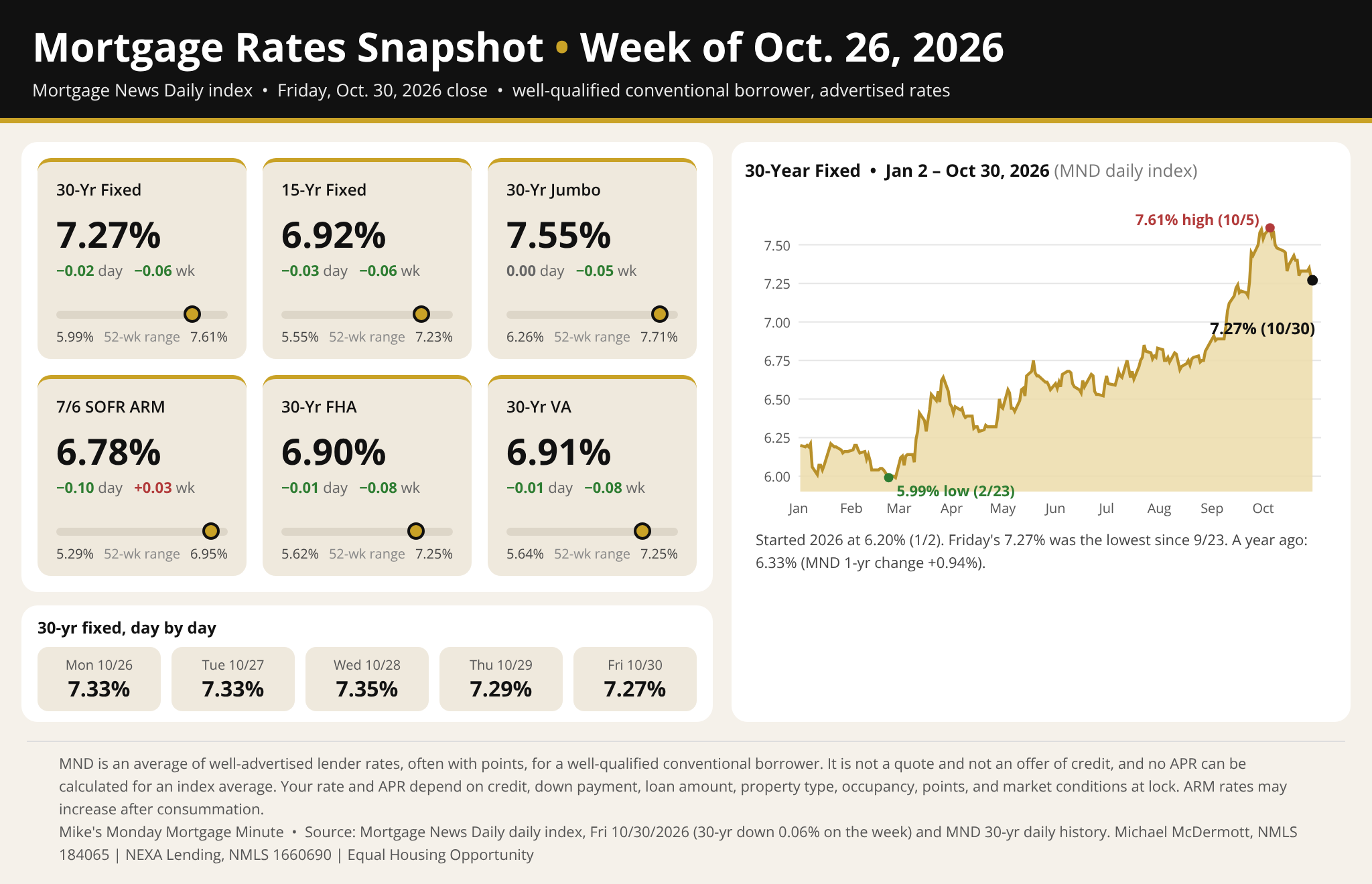
As of Friday, the Mortgage News Daily index for a well-qualified conventional 30-year fixed was 7.27%, down 0.06% for the week (from 7.33%), its lowest level since September 23rd and down from 7.61% at its October high.
Here’s why that’s unusual. Look at what we got last week: the first read on third-quarter GDP showed the economy grew at 3.4% (up from 2.2% in the second quarter), powered by consumer spending, government spending and business investment, including all those AI data centers. A 3.4% reading is strong to very strong. Weekly unemployment claims held steady around 194,000, and continuing claims edged down to 1.7 million, so layoffs are still limited. Core inflation is stuck at 3.1%, and the Fed said flat out that “inflation remains elevated,” with two members voting to hike. Strong growth, sticky inflation, and a hawkish Fed would normally push mortgage rates higher. In fact, on Fed Day itself, rates did tick up slightly.
So why did they fall? The tech sector. The rate market has been taking its cues from turmoil in tech for several weeks. On Thursday, disappointing earnings, and weak guidance from big names like Alphabet, Intel and Amazon revived worries about the AI spending boom, tech stocks slid, and investors moved money into the safety of bonds. When bonds are in demand, rates go down. On Friday, a report that Anthropic’s credit rating likely won’t be “investment grade” helped bonds again. That matters for two reasons: higher borrowing costs for AI companies could mean less of the corporate debt issuance that’s helped push rates up this year, and any stumble in AI raises questions about growth, since AI is driving so much of this economy.
The takeaway: last week’s improvement came from tech jitters, not from better inflation news. That’s a risk to keep in mind. If the tech selloff stops or reverses, that support for bonds can fade quickly, and the inflation and Fed picture would be front and center again. This week is all about jobs, and it comes with the midterm elections on Tuesday. Here’s why that matters for rates.
Remember, last week’s rate improvement came from tech jitters, not from the economy cooling off. That makes this week’s jobs data a real test. Signs that hiring is slowing would give bonds a more solid reason to rally and help rates hold onto their gains. Signs that the job market is still strong would put the focus back on inflation and the Fed’s hike talk, and that tends to push rates up.
The reports build through the week. On Tuesday we’ll see how many job openings employers have, and on Wednesday we get a private payrolls preview from ADP plus a check-in on the service side of the economy, where most Americans work. Those are early clues. Thursday brings weekly jobless claims, and Beth Hammack, one of the two Fed members who wanted a hike last week, speaks that morning. If she doubles down, expect the rate hike chatter to get louder.
The big one is Friday’s October jobs report at 6:30 a.m. Arizona time. September added just 29,000 jobs, and Barclays expects about 50,000 for October. A number well above that could push rates higher quickly. A number well below it, or a jump in the unemployment rate, could help rates improve. Two more Fed speakers follow later that morning, including St. Louis Fed President Musalem, who said last week that more hikes are needed “soon.”
As for the elections, they can stir up some day-to-day volatility. Over the long run, though, inflation and jobs data matter far more for mortgage rates than who wins.
Here’s how rates ended the week:
If you have any questions or would like to discuss this week’s newsletter further, please don’t hesitate to reach out. Have a great week!
Sources
- Federal Reserve, FOMC statement, October 28, 2026
- Bureau of Economic Analysis, Personal Income and Outlays, September 2026 (PCE)
- Bureau of Economic Analysis, GDP advance estimate, third quarter 2026
- CME FedWatch
- Fannie Mae, Uniform Appraisal Dataset (UAD 3.6)
- Freddie Mac, Uniform Appraisal Dataset (UAD 3.6)
- U.S. Census Bureau, New Residential Sales, September 2026
- S&P Cotality Case-Shiller U.S. National Home Price Index, August 2026
- FHFA House Price Index, August 2026 (published October 27, 2026)
- Mortgage News Daily rate index