
Happy Tuesday! With the bond market closed yesterday for Columbus Day, this week’s Minute is coming to you a day late. Last week the Fed’s minutes confirmed what Fed speakers have been telling us for weeks, a European bond selloff spilled into our own rates, and mortgage rates finally caught a small break, finishing Friday at a two-week low. There’s a lot to cover, so this one is about a 5-minute read. Let’s get into it!
- Fed Minutes: Most Officials See Another Hike by Year End
- Europe’s Bond Selloff Spilled Into U.S. Rates
- Cotality: Home Prices Firm in August, Softer Months Ahead
- Weekly Rate Recap and What to Expect This Week
- What I’d Tell a Buyer or Seller This Week
Fed Minutes: Most Officials See Another Hike by Year End
On Wednesday, the Fed released the minutes from its September 15–16 meeting, where it raised the federal funds rate 0.25% to a range of 3.75% to 4.00%. The line that matters: “most participants assessed that another increase in the target range for the federal funds rate would likely be appropriate by year end.” The minutes did not pin that next hike on the October 27–28 meeting, and officials stressed they approach each meeting “with an open mind.”
A few takeaways worth passing along:
- Inflation is the whole story. Officials said they “had not seen sufficient progress on lowering inflation in recent months.” Fed staff estimated PCE inflation at 3.8% in August, with core at 3.4%. Oil, the AI buildout, and leftover tariff effects were all named.
- The risks are tilted one way. Participants generally saw inflation risk “skewed to the upside,” and some worried that after more than five years above 2%, inflation could start to shape how businesses set prices and wages.
- The Fed sees the housing pain. A few officials singled out housing as the one sector where financial conditions are not supportive, “with mortgage rates remaining at elevated levels.” Staff also noted mortgage rates rose a bit more than the 10-year Treasury between meetings.
- Several officials said they view today’s 3.75%–4.00% funds rate as “not restrictive or only mildly restrictive.” Translation: they think there’s room to go higher if they need to.
Fed Governor Christopher Waller backed that up Thursday, saying he anticipates “additional hikes” if the data come in as expected, but that “the hikes do not need to come at consecutive meetings.” He noted futures pricing as of Wednesday showed about an 85% chance of at least one more hike by the December meeting.
Same reminder as always: the federal funds rate is not your 30-year fixed rate. HELOCs and credit cards feel a hike first. Mortgage rates live off the 10-year Treasury, inflation expectations, and the spread between Treasuries and mortgage-backed securities.
Europe’s Bond Selloff Spilled into U.S. Rates
This one doesn’t come up much in buyer conversations, but it mattered last week. France has been at the center of a European bond selloff. Its 10-year yield jumped about 0.70% in September and touched roughly 4.99% in early October — the highest since 2002 — on worries about its deficit and political gridlock ahead of next April’s presidential election. The extra yield investors demand to hold French debt over German debt topped 1.50%, the widest in nearly 15 years. It wasn’t just France: Germany’s 10-year hit 3.65%, its highest since 2009, and the UK’s 30-year gilt topped 6% for the first time since 1998.
So why does a French bond matter to a buyer in Gilbert or Glendale? Global bond markets compete for the same pool of investor dollars. When investors can earn more on European or UK government debt, U.S. Treasuries have to offer a higher yield to keep attracting buyers. Add heavy U.S. Treasury issuance on top of that and you get upward pressure on the 10-year. Mortgage rates are priced off the 10-year plus a spread, so that pressure lands right on rate sheets.
Last Monday the 10-year closed at 5.31%, its highest since 2002. The good news is things calmed down as the week went on. A strong $39 billion 10-year Treasury auction Wednesday, solid demand at Thursday’s 30-year auction, and a dip in oil helped pull yields off the highs. The 10-year finished Friday at 5.24%, down 0.04% on the week. Some strategists are even making the case that France’s trouble could eventually push global money toward Treasuries as the relative safe haven, which would help U.S. rates. Early this morning the 10-year was around 5.18% as a tech-stock selloff sent some money into bonds. One morning doesn’t make a trend, but it’s a step in the right direction.
Cotality: Home Prices Firm in August, Softer Months Ahead
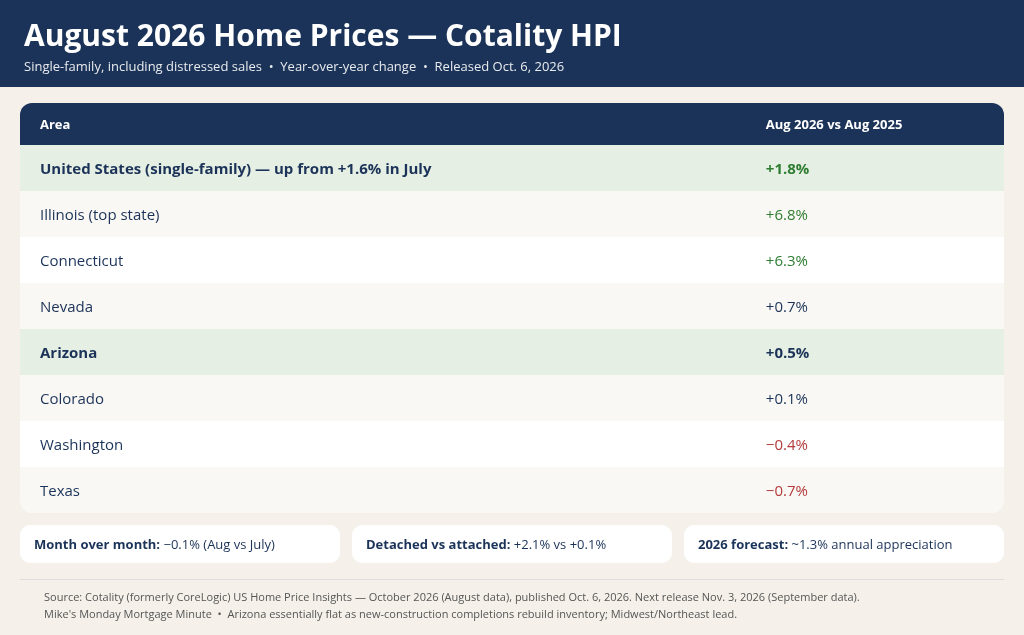
Cotality (formerly CoreLogic) released its Home Price Index last Tuesday. Nationally, single-family home prices rose 1.8% year over year in August, up from 1.6% in July — the fifth straight month of reacceleration. Month over month, prices slipped 0.1%. Cotality pointed out that August mostly reflects deals locked before the late-August rate jump.
The forward look is softer. Cotality says buyer pullback showed up in September pending sales, and its forecast calls for month-over-month price declines through the winter, with about 1.3% appreciation for all of 2026. Chief Economist Selma Hepp noted that many buyers halt their searches when rates top 7%, but as expectations shift to “higher for longer,” some may decide to buy rather than keep waiting.
Two details worth noting for us here in Arizona:
- Arizona prices were up 0.5% year over year in August — essentially flat — alongside Nevada (+0.7%) and Colorado (+0.1%). Cotality credits more new-construction completions and buyer pushback on monthly payments for rebuilding inventory in these markets. The strongest gains are in the Midwest and Northeast, led by Illinois at +6.8%.
- Condos and townhomes were up just 0.1% nationally versus 2.1% for detached homes, with rising HOA dues, special assessments, and insurance costs weighing on attached properties.
Weekly Rate Recap and What to Expect This Week
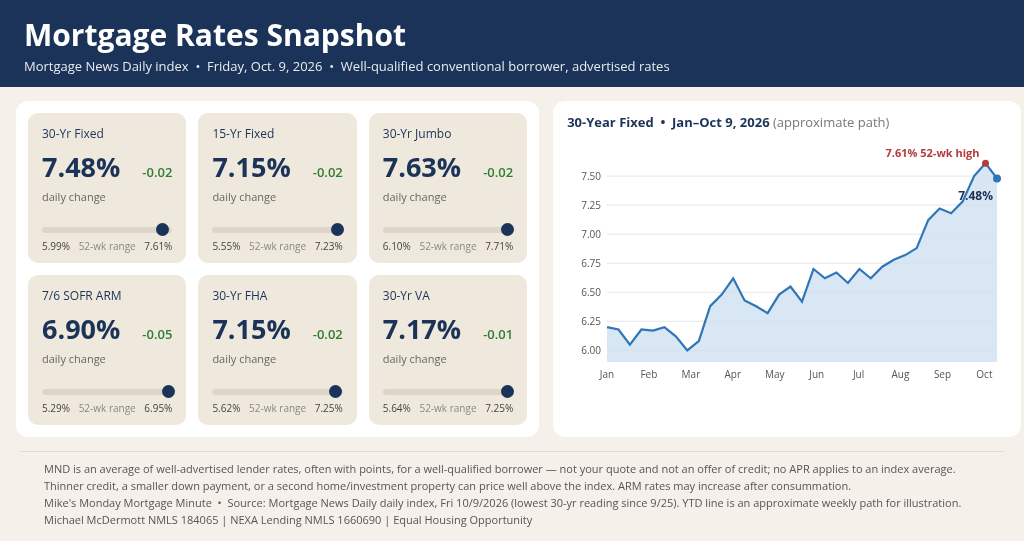
Rates caught a small break last week. As of Friday, the Mortgage News Daily index for a well-qualified conventional 30-year fixed was 7.48%, its lowest since September 25 and down from a 52-week high of 7.61% in early October. The 15-year was 7.15%, jumbo 7.63%, 7/6 SOFR ARM 6.90%, FHA 7.15%, and VA 7.17%. These are averages of advertised rates, often with points, for a top-tier borrower — not a quote. Thinner credit, a smaller down payment, or a second home or investment property can price well above the index.
Perspective cuts both ways. We started the year around 6.2%, bottomed near 6.0% in late February and early March, and climbed steadily from there. We’re still well above where we were at the end of August. But Friday was the strongest pushback we’ve seen since rates took off.
It’s a short week, but a loaded one:
- Wednesday: CPI, the September consumer inflation report, at 8:30 a.m. Eastern (5:30 a.m. Arizona time). This is the big one. The Fed’s Beige Book follows that afternoon.
- Thursday: PPI (wholesale inflation), September retail sales, and weekly jobless claims, all at 8:30 a.m. Eastern (5:30 a.m. Arizona time).
- Friday: industrial production.
- Fed speakers: Governor Waller and Vice Chair for Supervision Bowman are speaking overseas this week, and Chair Warsh joins IMF Managing Director Kristalina Georgieva for a fireside chat in Bangkok Thursday evening our time (8:30 p.m. Arizona).
This is the last CPI report before the Fed’s October 27–28 meeting. A hot reading, especially on core inflation, would likely firm up the odds of an October hike and could push rates back toward the highs. A cooler reading could extend Friday’s relief. Either way, expect rates to move Wednesday morning. Keep one eye on CPI and the other on the 10-year. Here’s a snapshot of how the week ended, and rates year-to-date.
What I’d Tell a Buyer or Seller This Week
For Realtors and sellers:
- Concessions can work harder as a rate buydown than as a price cut. A permanent buydown lowers the rate for the life of the loan. A temporary buydown (a 2-1, for example) lowers the payment for the first year or two, then it goes back to the full note rate. On conventional loans the buyer still must qualify at the full note rate, so a temporary buydown helps cash flow, not approval.
- Know the concession caps before you write them in. Conventional runs 3% to 9% of the price depending on the down payment (2% on investment properties), FHA allows up to 6% of the sales price, and VA caps concessions at 4% of the appraised reasonable value (normal closing costs don’t count toward that 4%). I’m happy to run a buydown versus a price reduction side by side for any buyer you’re working with.
- Condos: with attached-home prices nearly flat nationally, get the HOA budget, reserves, and insurance information early. That’s where condo deals have been getting stuck.
For buyers and homeowners:
- Look at all three loan types. On Friday’s index, FHA and VA averaged roughly 0.30% below conventional. FHA carries mortgage insurance but so can Conventional, and VA has a funding fee (unless you’re exempt), so the lowest rate isn’t always the lowest total cost. That’s what a side-by-side is for.
- ARMs deserve a look, with eyes open. The 7/6 SOFR ARM averaged 6.90% versus 7.48% for the 30-year fixed. The rate is fixed for the first seven years, then can adjust every six months — up or down — within caps, and the rate may increase after closing. It can make sense if you realistically expect to sell or refinance within that window. It’s not a fit if you need payment certainty.
- Have a lock plan before Wednesday. If you’re under contract, decide your plan before the CPI report, not after it. Ask about float-down options; they vary by lender and usually come with a cost.
- If you’re waiting on lower rates, compare buying now against waiting without assuming rates will be lower later. A future refinance is an option, not a promise, and it has its own costs.
If you have any questions or would like to discuss this week’s newsletter further, please don’t hesitate to reach out. Have a great week!
Rates referenced are Mortgage News Daily national index averages of advertised rates as of Friday, October 9, 2026, shared as market commentary only. They are not an offer of credit or a rate quote from Michael McDermott or NEXA Lending, and an APR cannot be calculated for an index average. Your actual rate and APR depend on credit, loan amount, down payment, property type, occupancy, points, and market conditions at the time of lock. ARM rates may increase after consummation. All loans are subject to credit approval and program guidelines.
Michael McDermott, MLO NMLS 184065 · NEXA Lending, Company NMLS 1660690 · AZBK 2006218 · Equal Housing Opportunity