
Good morning!
It was a historic week for rates, now hitting 7.50% for the most well-qualified buyers. Comments from Fed officials and headlines surrounding the conflict with Iran added to market volatility, while new-home sales reached their highest pace of the year. We have a little more to discuss than usual, so this week’s newsletter is about a 5-minute read. Let’s get into it!
- Fed Comments, Geopolitical News Pressuring Yields and Rates
- New Home Sales Strengthen in August
- Weekly Rate Recap and What to Expect This Week
Fed Comments, Geopolitical News Pressuring Yields and Rates
Last week, I said the grade after the Fed hike would be whether the bond market decided the Fed had done enough on inflation, oil included. The bond market answered last week, with a clear….no.
On Wednesday, Fed Governor Michael Barr said more rate increases may be needed to get inflation back to 2% “in a timely fashion.” He pointed to inflation risks rising — energy and oil are the obvious ones — while risks to the job market have eased. Thursday, New York Fed President John Williams and Philadelphia Fed President Anna Paulson both left the door open for another hike. That is three officials in two days telling markets the September 0.25% move may not be the last hike of the year.
A reminder, because this still gets mixed up in buyer conversations: the federal funds rate is the overnight rate banks charge each other. It is not your 30-year fixed rate. HELOCs and credit cards feel these hikes first. Mortgage rates live off the 10-year Treasury, inflation expectations, and the spread between Treasuries and mortgage-backed securities. When Fed speakers sound more hawkish, the 10-year usually backs up first, and advertised mortgage rates follow.
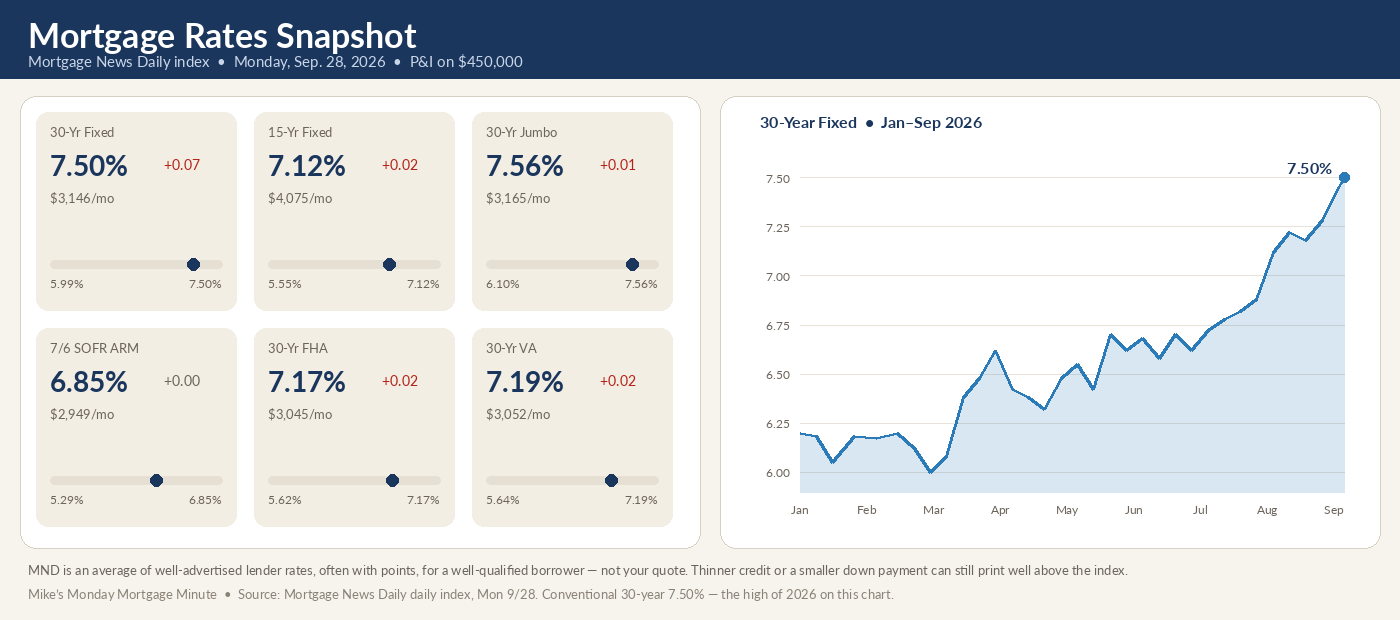
Geopolitics piled on. Remarks from President Trump and Iranian President Masoud Pezeshkian at the U.N. General Assembly kept the oil-and-conflict concerns alive in the bond market. The Fed has two meetings left in 2026 — October 27–28 and December 8–9. After last week’s comments, markets raised the odds of another quarter-point in October. That does not lock a hike in. It does explain why a 7% conventional quote became 7.50% for even a well-qualified borrower on the Mortgage News Daily average, which is advertised rates, often with points.
New Home Sales Strengthen in August
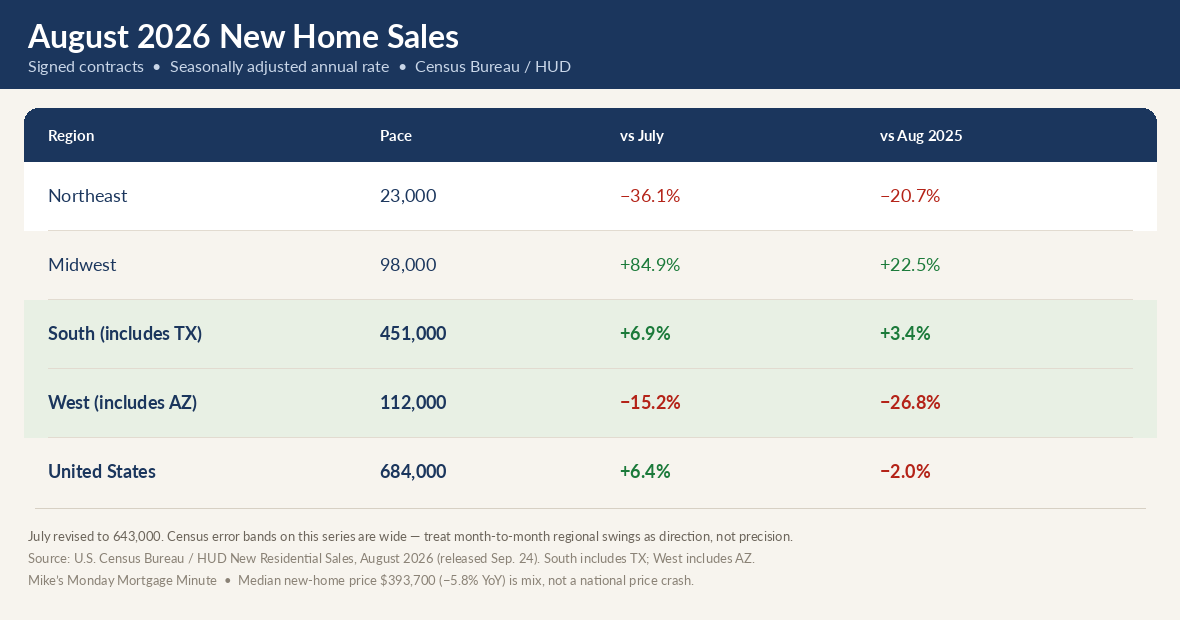
August new-home sales came in at a seasonally adjusted annual rate of 684,000. That is 6.4% above July and the strongest pace so far this year. July was also revised higher, from the first print up to 643,000. Compared with August 2025, sales are still down 2.0%. This report counts signed purchase contracts, not closings, so it is a look at what buyers were willing to write in August — when rates were still in the high-6s and early-7s, not at this morning’s 7.50% conventional average.
The headline that will get forwarded is the median new-home price down 5.8% year over year to $393,700. That is mix, not a national value collapse. More of the contracts written in August were on homes under $500,000, which pulls the median down even when individual house prices are not falling. Month over month the median ticked up 0.4%. Broader existing-home data is still pointing to price appreciation nationally. Inventory of new homes for sale was unchanged at 483,000, or 8.5 months of supply — builders still must compete, which is why buydowns and closing-cost help remain the listing conversation on new construction.
Regionally it was not one market. The Midwest rose 84.9% from July and is up 22.5% year over year! The West fell 15.2% from July and is down 26.8% year over year.
Weekly Rate Recap and What to Expect This Week
If you’ve been waiting for lower rates to pull the trigger on a purchase or a refinance, last week was a reminder of how edgy this market is about inflation still being in front of us — oil in particular. Since the beginning of September, the Mortgage News Daily average for a well-qualified conventional 30-year has gone from about 6.9% to 7.50%. That is a powerful move in a short span for long-term rates.
The driver was the 10-year Treasury we flagged last Monday. We spent that letter watching whether 5.00% would hold. It did not. The 10-year ran as high as 5.23%, a level last seen in 2007, right as the financial-crisis era was getting started. A 5.20% 10-year plus a roughly 2.3-point mortgage spread is how you get a 7.50% conventional average. As long as the 10-year holds 5.20%+, 7.50% rates hold with it.
One thing we have not talked about since 2021 is the MOVE index, and it is starting to matter again. MOVE measures expected volatility in the Treasury market — the bond market’s version of the VIX. It had been fairly tame for most of the last 18 months. Last week it jumped. Here is the uncomfortable truth, and the silver lining in the same breath: when advertised 30-year rates topped 8% in late 2023, the 10-year was not even this high. The bond market was much more volatile then, which meant MOVE was higher, and lenders demanded a wider spread. So, when the 10-year was around 5% in that cycle, mortgage rates were over 8%. Believe it or not, rates could be worse today than they are. If MOVE keeps climbing, that spread between the 10-year, and mortgage rates can widen. That is how investors protect themselves — if the bond market feels unstable, they want more return to hold the paper.
Looking ahead, it is a busy week. Tuesday brings Case-Shiller and FHFA home-price indexes plus job openings. Case-Shiller tracks repeat sales of the same existing homes in major metros; FHFA is a broader purchase set. Wednesday is the final read on second-quarter GDP, private-sector payrolls, and PCE — Personal Consumption Expenditures, the inflation gauge the Fed prefers, with “core” PCE stripping out food and energy. Thursday is weekly jobless claims. Friday is the employment report: nonfarm payrolls and the unemployment rate.
From a rate perspective, anything that indicates climbing inflation or a strong/strengthening job market could pour salt on an open wound and deteriorate rates further. Either of those would also increase the likelihood of another Fed Rate hike in October.
Keep one eye on oil and the other on the 10-year. That is still the grade: has the bond market decided the Fed has done enough? Last week’s answer was no.
If you have any questions or would like to discuss this week’s newsletter further, please don’t hesitate to reach out. Have a great week!