
Good morning!
The latest inflation data leaves the door wide open for a Fed rate hike this week, while existing home sales declined for the third consecutive month. There’s no way to sugarcoat this week’s market recap. For rates, Thursday was the single worst day for rates going back to March 22, 2022, which was when rates were quickly rising from ~4.25% on the march to 7.5%. The market is sending a clear signal so let’s buckle in and get into it…
- Inflation Data Keeps Fed Rate Hike in Play
- Rising Oil Prices Take Control of Mortgage Rates
- Existing Home Sales Ease Again
- Weekly Rate Recap and What to Expect This Week
Inflation Data Keeps Fed Rate Hike in Play
Core inflation, which excludes food and energy, rose 0.3% for the month but fell to 2.4% year over year – its lowest level in more than five years. On the surface, this sounds like bond-friendly, and rate-friendly news but that monthly reading of 0.3% was enough to push the chance of a rate hike this week from about 50% to now 87-90%. There’s a sense of patience running thin in the bond market; starved for sub-2.0% inflation. It’s as though the bond market is reminding the Federal Reserve that this battle against inflation has been ongoing for 5+ years.
There is a silver lining to all of this. There’s a saying in the bond market – “the cure for higher rates, is higher rates.” That may sound counterintuitive but as yields rise, it entices more investors to buy mortgage-backed securities which in turn starts to lower rates. Think of it this way: if you were going to buy a treasury bond, would you rather buy one that guarantees you 3%, 4%, or 5% for a return? The obvious answer is 5% and that’s where we find ourselves today with the 10-year treasury creeping right up to 4.98% at this hour. The higher rates, or yields are, the more it attracts buyers to come back into the market to buy these bonds and treasuries, which then pushes rates lower. The question is, are rates high enough to spark this interest yet…
Rising Oil Prices Take Control of Mortgage Rates
A stronger than expected jobs report followed by Friday’s inflation report, put rates at their highest level in over a year. Unfortunately, the hits keep coming on the news of Saudi Arabia closing their East-West oil pipeline that was carrying 5-7 million barrels per day as a bypass to using the Strait of Hormuz. The closure comes after an Iran backed military group in Iraq used drones to attack the pipeline. The severity of the damage and length of closure is unknown but this anticipated reduction in oil supply has oil surging up above $104/barrel this morning.
In addition, the Houthis have reportedly seized the strategic Perim Island in the Bab el-Mandeb Strait after taking over the port city of Mokha on Yemen’s Western coast. The advances here allow them to cause even more disruption of oil flow through the Red Sea. The bottom line is that the markets not just here but abroad, are bracing for higher oil prices, which leads to higher inflation readings, and thus, higher interest rates. With the stronger than expected jobs report, and a ho-hum inflation report, and now what’s expected to be further restriction in oil supply, the economic environment is not set up to be particularly friendly for oil prices, and rates.
Existing Home Sales Ease Again
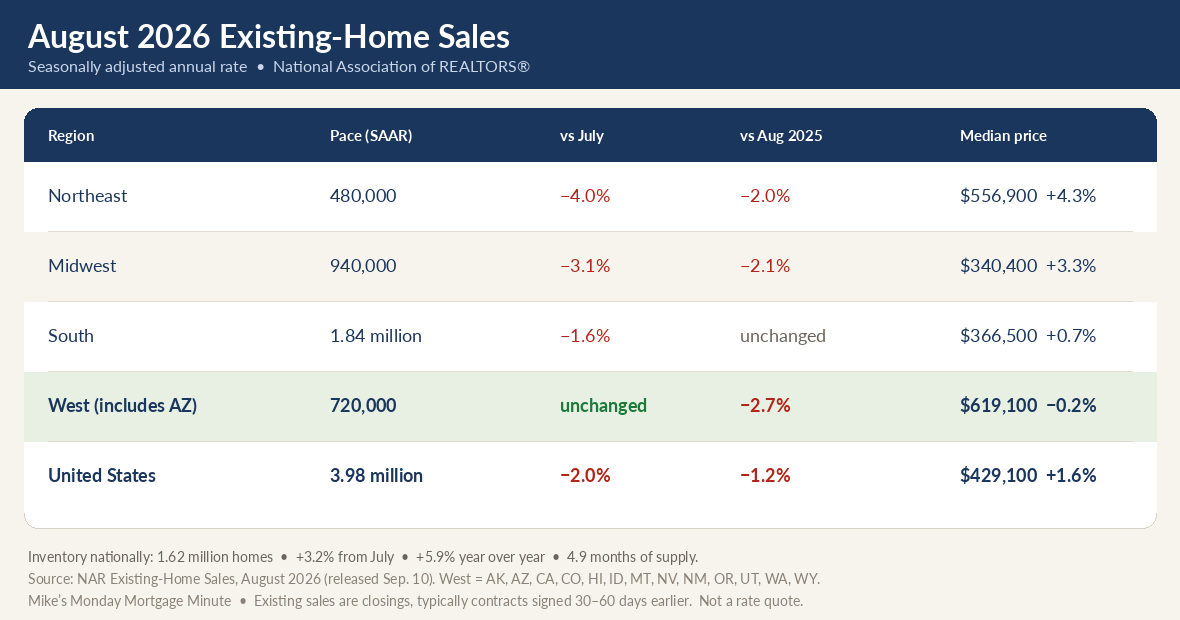
Existing home sales fell 2% from July to August, marking the third consecutive monthly decline. Sales reached a seasonally adjusted annual rate of 3.98 million homes which is 1.2% lower than August 2025 levels. Meanwhile, inventory continues to build as homes sit on the market longer. The number of homes available for sale increased 3.2% from July and sit 5.95% higher than a year earlier on a national level.
National Association of Realtors Chief Economist, Lawrence Yun, noted that mortgage rates and home sales typically move in opposite directions, so the recent dip in sales isn’t surprising given today’s higher rates. It’s worth noting that these August figures likely reflect June and July rate locks which hovered around the mid-upper 6% range. Rates are squarely above 7% now so we can likely expect sales to slow again in September. Despite everything, year-to-date sales are up 1.6% so far this year (Jan-Aug 2026 vs Jan-Aug 2025). Here’s how each region fared in August existing home sales:
Weekly Rate Recap and What to Expect This Week
The Federal Reserve’s meeting is already upon us this week. The meeting begins Tuesday with the Fed’s policy announcement and press conference to follow on Wednesday afternoon. The prediction markets are expecting a 0.250% rate hike, to the tune of a 87-90% chance as of this morning. Fed Chair Warsh has been outspoken about the desire to steer clear of rate hikes if possible but the pressure to do something is palpable – if a rate hike doesn’t happen this week, the markets will be waiting for aggressive balance sheet reductions in lieu of that.
One thing is for sure – if the Federal Reserve does not hike or announce a shift in monetary policy, the market will likely sell bonds and push mortgage rates higher. We could see a .250% rate hike, and/or an announcement to begin aggressive balance sheet reduction. The irony is, mortgage rates will respond positively to aggressive action. Remember that when the Federal Reserve raises rates, it does not mean mortgage rates go up with it. If the bond market is convinced that the Federal Reserve took decisive action to address inflation concerns, mortgage rates will improve. However, if the bond market is not convinced that their decisions will help, mortgage rates could deteriorate further.
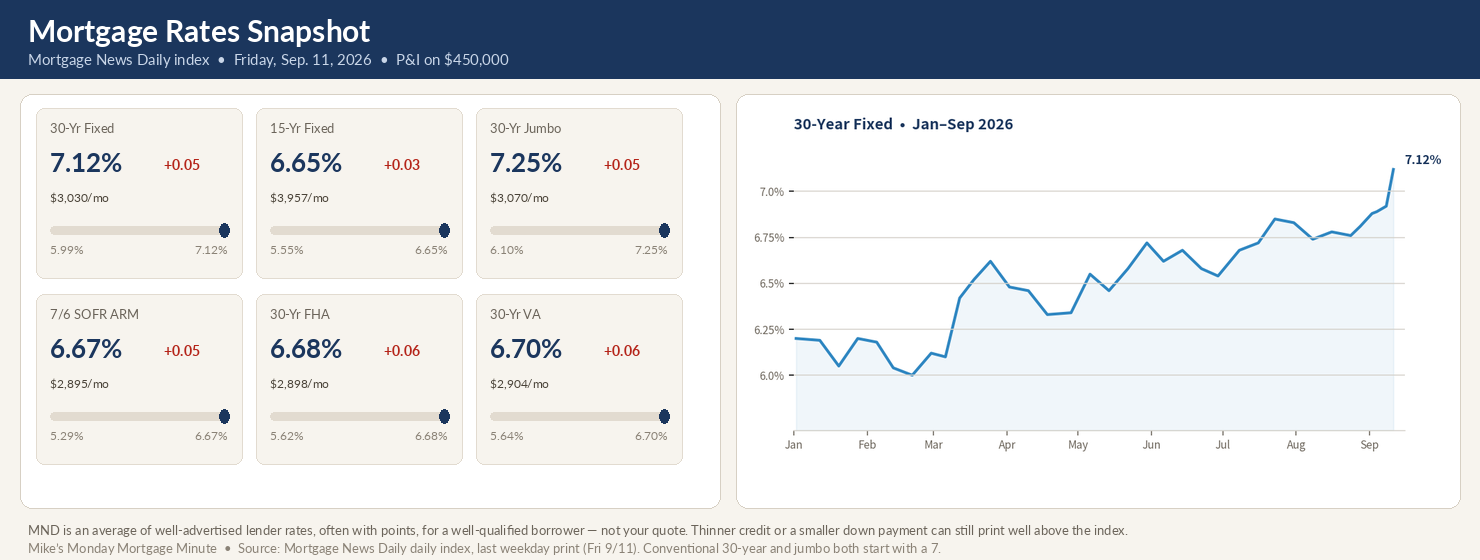
We’ve already touched on rates today, so I won’t go into too much further here. In short, Conventional and Jumbo rates are now above 7% even for the most well-qualified buyers. FHA and VA remain in the mid-upper 6% range as they typically offer rates about .500% better than Conventional at any given time. These rates represent hundreds of mortgage companies “advertised rates” which means these rates likely come with points/discount fees as well. Vacation homes and investment properties have popped into the low-8% range for 30-year fixed rates as well.
I hope you found this week’s newsletter insightful. As always, please don’t hesitate to reach out if you have any questions!